
DeHumidifiers
Industrial Humidity Management: Managing Humidity to Prevent Warehouse Spoilage
Feb
Relative humidity – %RH control is a critical environmental parameter in industrial storage facilities, particularly those handling high-value commodities such as pharmaceuticals, processed agricultural products, tea, coffee, grains, and metal components. Moisture imbalance directly affects chemical stability, structural integrity, microbial growth risk, and regulatory compliance.
Relative humidity represents the percentage of moisture in air relative to the maximum amount air can hold at a given temperature. For most controlled industrial environments, the recommended RH range lies between 40% and 60%. Deviations outside this band create measurable operational risk.
Pharmaceutical products are especially sensitive to moisture. Tablets and capsules often contain hygroscopic excipients that absorb moisture from the air. Elevated humidity accelerates hydrolysis reactions, reduces active ingredient potency, and compromises dissolution rates. In extreme cases, tablets may swell, crack, or stick together due to moisture absorption.
The World Health Organization (WHO) guidelines for pharmaceutical storage emphasize environmental monitoring, including humidity control. Many drug storage facilities maintain RH below 60%, and in certain cases closer to 45%–55%, to preserve product stability.
High humidity also encourages fungal growth in stored commodities such as tea leaves, coffee beans, maize, and dried herbs. Fungal contamination not only reduces quality but can lead to mycotoxin formation. Aflatoxins, produced by certain molds in humid conditions, pose serious health risks and export rejection consequences.
Metal components and machinery parts are equally vulnerable. When relative humidity exceeds approximately 60%, corrosion risk increases significantly. Moisture condenses microscopically on metal surfaces, initiating oxidation reactions. For export-oriented industries, corrosion reduces product value and increases warranty claims.
Humidity fluctuations compound risk. Repeated cycles of high and moderate humidity cause expansion and contraction in packaging materials. Corrugated cartons absorb moisture, weaken structurally, and may collapse under stacking load.
Temperature interacts closely with humidity. Warm air holds more moisture than cold air. When warm, humid air enters a cooler warehouse, condensation may occur on surfaces if temperature drops below the dew point. Condensation creates localized high-moisture microenvironments even if average RH readings appear moderate.
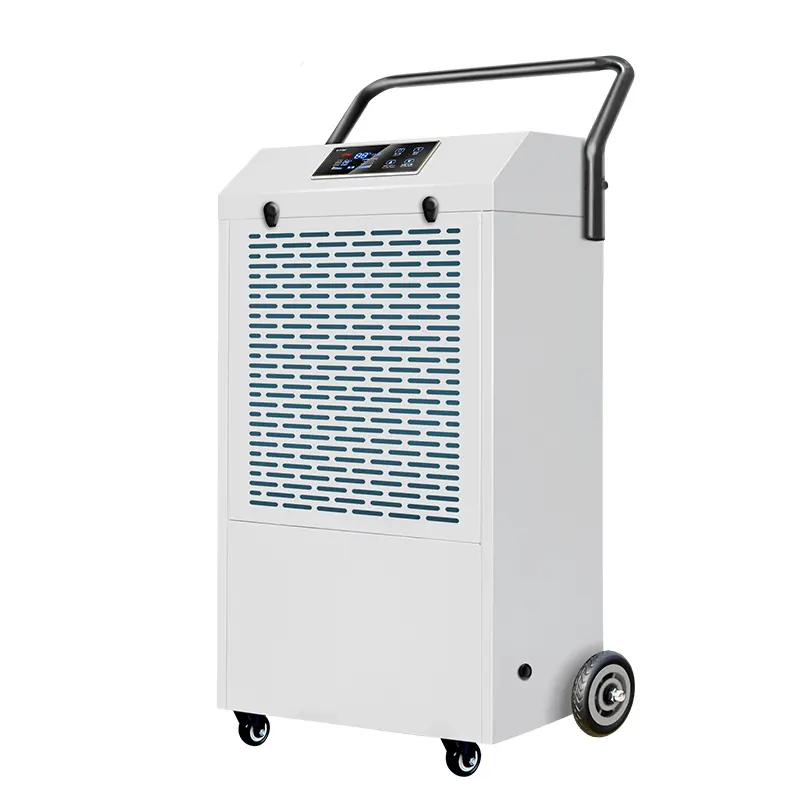
Industrial humidity management relies on two primary technologies: refrigerant-based dehumidifiers and desiccant dehumidifiers.
Refrigerant systems operate by drawing moist air across cooled coils. As air temperature drops below its dew point, moisture condenses and is collected. The dried air is then reheated slightly before reintroduction into the environment. Refrigerant systems are effective in moderate temperature conditions and are commonly used in warehouses.
Desiccant systems use moisture-absorbing materials such as silica gel or molecular sieves. Air passes over the desiccant rotor, where moisture is adsorbed and later expelled during regeneration cycles. Desiccant dehumidifiers perform effectively even in lower-temperature environments and allow precise humidity control.
Extraction capacity is measured in liters per day (L/day). Proper sizing depends on:
- Warehouse volume (cubic meters)
- Air exchange rates
- External climate
- Internal moisture sources
- Frequency of door openings
Under-sizing equipment results in inadequate moisture removal and continued risk.
Continuous monitoring systems improve reliability. Wall-mounted hygrometers and digital data loggers provide real-time RH tracking. In pharmaceutical storage, environmental monitoring logs are often required for regulatory audits.
Moisture-related corrosion follows electrochemical principles. When a thin layer of water forms on metal surfaces, oxygen reacts with iron to produce iron oxide (rust). Corrosion rates increase sharply above 60% RH. Controlled humidity below this threshold significantly reduces oxidation rates.
High-value exports such as electronics require strict humidity control to prevent static discharge and component damage. However, excessive dryness below 30% RH may increase electrostatic discharge risk. Balanced control between 40% and 55% RH optimizes both corrosion prevention and static risk reduction.
Pharmaceutical cold chain storage adds additional complexity. Even in temperature-controlled environments, humidity must remain stable. Refrigeration alone does not guarantee moisture control. Condensation may form if humidity levels are not managed concurrently.
Mold growth in warehouses typically begins when surfaces remain damp for 24–48 hours. Mold spores are ubiquitous in ambient air and require only moisture and organic substrate to proliferate. Controlling humidity below 60% reduces fungal growth probability significantly.
Export rejection due to moisture damage represents substantial financial loss. International buyers may test shipments for moisture content and microbial contamination. Compliance with humidity standards enhances export reliability and brand credibility.
Moisture also affects labeling and packaging integrity. Adhesives may weaken under prolonged humidity exposure. Ink on packaging may smudge or fade in damp conditions.
Humidity management contributes to occupational safety. High humidity combined with elevated temperatures increases perceived heat stress for workers. Stable indoor humidity supports more comfortable working conditions.
Energy efficiency must be considered. Continuous dehumidification consumes electricity. Integrated building management systems allow humidity setpoints to adjust automatically based on real-time readings, optimizing operational cost.
Industrial audits increasingly evaluate environmental controls as part of quality assurance systems. Documentation of humidity monitoring demonstrates proactive risk management.
In regions experiencing seasonal rainfall, such as Nairobi’s long and short rainy seasons, external humidity levels rise significantly. Warehouses without adequate sealing or dehumidification may experience internal RH spikes.
Loading docks represent critical infiltration points. Rapid door opening cycles allow humid outdoor air entry. Air curtains and rapid door systems can reduce moisture intrusion.
Moisture management should be integrated into risk assessment planning. Identifying high-risk zones within warehouses—such as corners, near roof leaks, or adjacent to exterior walls—allows targeted intervention.
Routine maintenance of dehumidification equipment ensures sustained performance. Filters must be cleaned or replaced regularly. Condensate drains must remain unobstructed.
Humidity management protects:
- Chemical stability
- Structural integrity
- Export compliance
- Financial investment
Industrial moisture control is a preventive strategy rather than reactive correction. By maintaining RH within controlled thresholds, storage facilities preserve product value, minimize spoilage, and reduce regulatory exposure.

Pingback: hello world
Pingback: metoprolol generic
Pingback: zpac